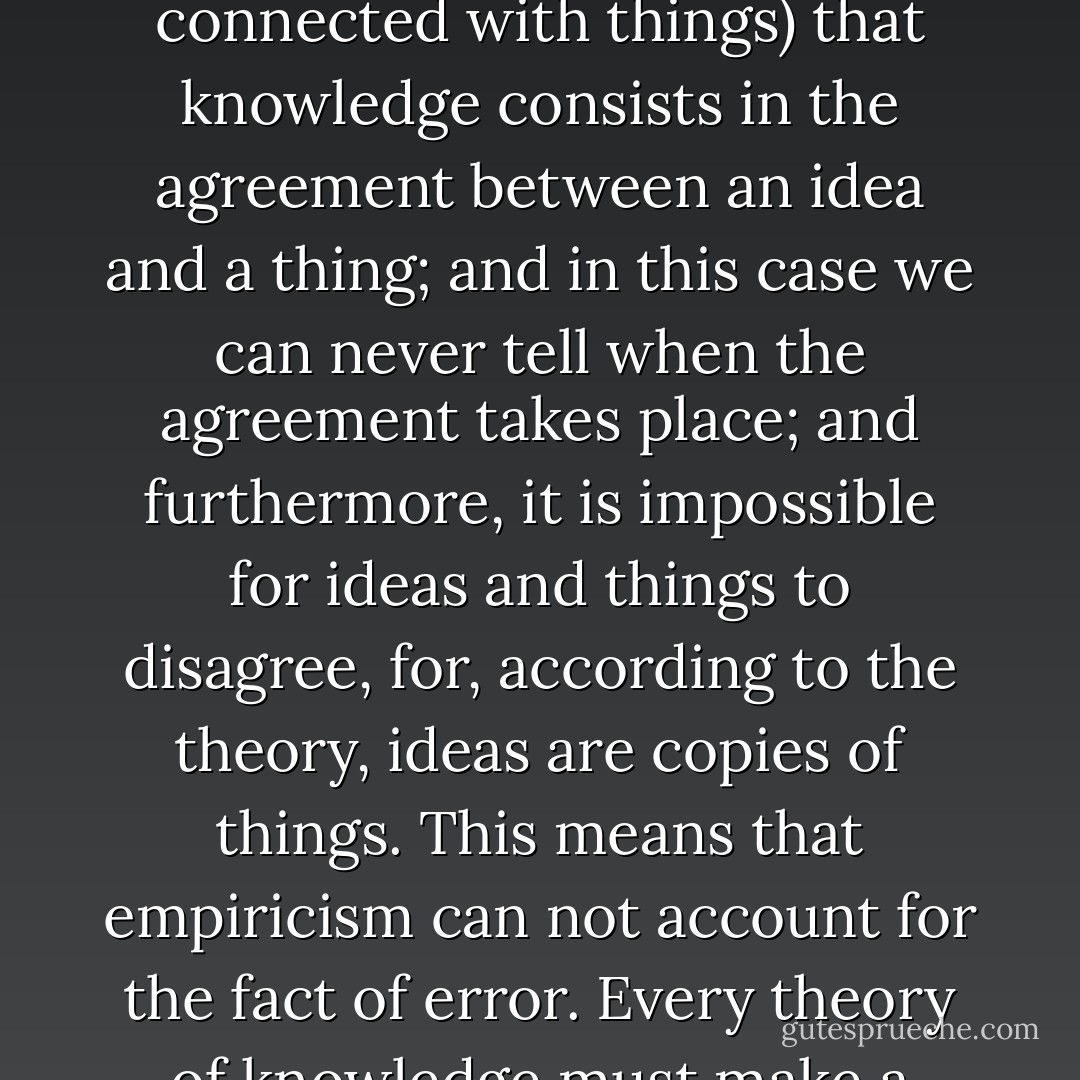
…let us point out precisely the difficulties of empiricism as a theory of knowledge. First, it begins with two fixed, unchangeable ultimates--mind and matter. Second, it asserts that knowledge is the agreement of ideas with each other, in which case we are not dealing with nature or things at all, and consequently, have left out one of our ultimates. Third, it then asserts (for it is essential that knowledge should somehow or other be connected with things) that knowledge consists in the agreement between an idea and a thing; and in this case we can never tell when the agreement takes place; and furthermore, it is impossible for ideas and things to disagree, for, according to the theory, ideas are copies of things. This means that empiricism can not account for the fact of error. Every theory of knowledge must make a place for error, for, as is evident, error seems to be as industrious as truth.
Consequently, if knowledge actually does take place, if there is such an activity, thing, or relation as knowledge, empiricism fails to give an account of it which is free from contradictions. The moral is, as the stories in our school readers say, don't begin with fixed things, for they beguileth one into inconsistencies.
Auteur: Holly Estil Cunningham

…let us point out precisely the difficulties of empiricism as a theory of knowledge. First, it begins with two <i>fixed, unchangeable</i> ultimates--mind and matter. Second, it asserts that knowledge is the agreement of ideas with each other, in which case we are not dealing with nature or things at all, and consequently, have left out one of our ultimates. Third, it then asserts (for it is essential that knowledge should somehow or other be connected with things) that knowledge consists in the agreement between an idea and a thing; and in this case we can never tell when the agreement takes place; and furthermore, it is impossible for ideas and things to disagree, for, according to the theory, ideas are <i>copies</i> of things. This means that empiricism <i>can not account for the fact of error</i>. Every theory of knowledge must make a place for error, for, as is evident, error seems to be as industrious as truth.<br />Consequently, if knowledge actually does take place, if there is such an activity, thing, or relation as knowledge, empiricism fails to give an account of it which is free from contradictions. The moral is, as the stories in our school readers say, don't begin with <i>fixed</i> things, for they beguileth one into inconsistencies. - Holly Estil Cunningham


©gutesprueche.com

Data privacy

Imprint
Contact
Wir benutzen Cookies

Diese Website verwendet Cookies, um Ihnen die bestmögliche Funktionalität bieten zu können.

OK Ich lehne Cookies ab