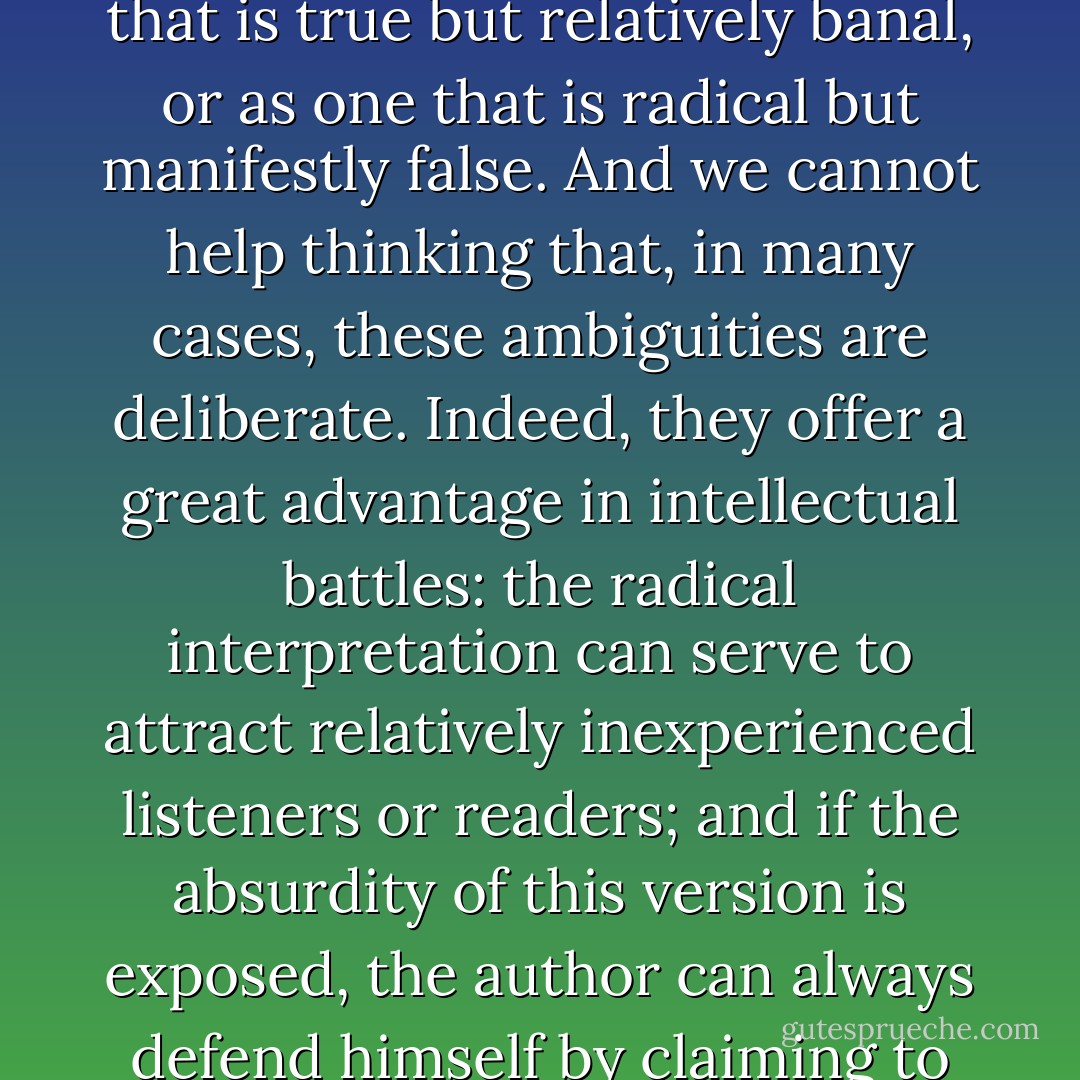
We have seen in this book numerous ambiguous texts that can be interpreted in two different ways: as an assertion that is true but relatively banal, or as one that is radical but manifestly false. And we cannot help thinking that, in many cases, these ambiguities are deliberate. Indeed, they offer a great advantage in intellectual battles: the radical interpretation can serve to attract relatively inexperienced listeners or readers; and if the absurdity of this version is exposed, the author can always defend himself by claiming to have been misunderstood, and retreat to the innocuous interpretation.
Auteur: Alan Sokal

We have seen in this book numerous ambiguous texts that can be interpreted in two different ways: as an assertion that is true but relatively banal, or as one that is radical but manifestly false. And we cannot help thinking that, in many cases, these ambiguities are deliberate. Indeed, they offer a great advantage in intellectual battles: the radical interpretation can serve to attract relatively inexperienced listeners or readers; and if the absurdity of this version is exposed, the author can always defend himself by claiming to have been misunderstood, and retreat to the innocuous interpretation. - Alan Sokal


©gutesprueche.com

Data privacy

Imprint
Contact
Wir benutzen Cookies

Diese Website verwendet Cookies, um Ihnen die bestmögliche Funktionalität bieten zu können.

OK Ich lehne Cookies ab