It is noteworthy that few works of fiction make marriage their central concern. As Northrup Frye puts it, with his accustomed clarity: 'The heroine who becomes a bride, and eventually, one assumes, a mother, on the last page of a romance, has accommodated herself to the cyclical movement: by her marriage...she completes the cycle and passes out of the story. We are usually given to understand that a happy and well-adjusted sexual life does not concern us as readers.' Fiction has largely rejected marriage as a subject, except in those instances where it is presented as a history of betrayal -- at worst an Updike hell, at best when Auden speaks of it as a game calling for 'patience, foresight, maneuver, like war, like marriage.' Marriage is very different than fiction presents it as being. We rarely examine its unromantic aspects.

Autore: Carolyn G. Heilbrun
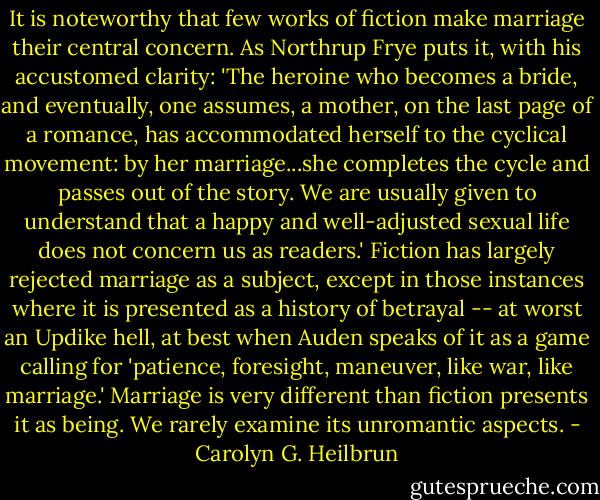
It is noteworthy that few works of fiction make marriage their central concern. As Northrup Frye puts it, with his accustomed clarity: 'The heroine who becomes a bride, and eventually, one assumes, a mother, on the last page of a romance, has accommodated herself to the cyclical movement: by her marriage...she completes the cycle and passes out of the story. We are usually given to understand that a happy and well-adjusted sexual life does not concern us as readers.' Fiction has largely rejected marriage as a subject, except in those instances where it is presented as a history of betrayal -- at worst an Updike hell, at best when Auden speaks of it as a game calling for 'patience, foresight, maneuver, like war, like marriage.' Marriage is very different than fiction presents it as being. We rarely examine its unromantic aspects. - Carolyn G. Heilbrun


©gutesprueche.com

Data privacy

Imprint
Contact
Wir benutzen Cookies

Diese Website verwendet Cookies, um Ihnen die bestmögliche Funktionalität bieten zu können.

OK Ich lehne Cookies ab